
The government has no say in where the country's refiners source oil from because these are commercial transactions.

The additional 25 per cent tariff imposed by US President Donald Trump on India is set to deliver a major blow to West Bengal's export-driven economy, with the state's labour-intensive leather, engineering and marine sectors expecting losses ahead of the festive season, stakeholders said. The increased levies on Indian products for the country's purchases of Russian oil came into effect on Wednesday, bringing the total amount of tariff imposed on New Delhi to 50 per cent.

'Future market gains will likely depend primarily on earnings growth.'

In trade negotiations, as in chess, sometimes you need to accept a temporary disadvantage to secure a better long-term position, points out Sonal Varma, chief economist (India and Asia ex-Japan) at Nomura.

Gold prices advanced Rs 700 to reach a new lifetime high of Rs 91,950 per 10 grams in the national capital on Wednesday on the back of continued buying by jewellers ahead of wedding season, according to the All India Sarafa Association. Besides, increased tensions in the Middle East and concerns about the US economic slowdown have kept the demand for safe-haven assets intact.

India should encourage the second coming of SAARC with climate change as an urgent agenda and keeping Indian security concerns in mind as the subtext, suggest Lieutenant General Ashok Joshi (retd) and Colonel Anil Athale (retd).

Analysts expect Nifty to rise up by to 6 per cent in six months, with intermittent corrections likely due to global factors.

The Kananaskis gathering on June 16-17 is the Prime Minister's 6th consecutive participation in the G7 Summit.

Gold is an excellent asset class for diversification and should be included in all long-term portfolios.

Israel's aerial assault on Iran is widely viewed as an act of naked aggression with no basis in international law, carried out unilaterally despite US opposition and aimed at derailing ongoing US-Iran nuclear negotiations, observes Ambassador M K Bhadrakumar.

From the outcome of the general elections and then Union Budget to tepid corporate earnings in the September 2024 quarter (Q2-FY25), sticky inflation and Reserve Bank of India's stance on interest rates, extreme weather conditions, Indian stock markets have braved it all in calendar year 2024.

India is preoccupied with analysing the US sanctions, which may cut off India's access to discounted Russian crude and force it to buy at market prices.

A lower risk appetite among investors has driven gold, traditionally a safe-haven asset, to record highs so far this year. Fuelled by geopolitical tensions in West Asia, robust demand from central banks - particularly in Asia - and US President Donald Trump's tariff volleys, spot gold touched an all-time high of $2,956 per ounce on February 24 in the international markets.

The Reserve Bank of India's (RBI's) interest rate decision, West Asia conflict and trading activity of foreign investors are the key factors that will dictate investors' sentiment in the market this week, analysts said. Moreover, quarterly earnings from IT bellwether TCS, domestic macroeconomic data and movement in global oil benchmark Brent crude would also guide trends in the market. Worsening tensions in the Middle East and foreign fund outflows were the major culprits behind the equity markets sharp fall last week.

From the 30 Sensex firms, Mahindra & Mahindra, Bajaj Finance, Asian Paints, Nestle, Bharti Airtel, UltraTech Cement, Hindustan Unilever, ITC, and HDFC Bank were the major laggards. In contrast, Infosys, Tech Mahindra, Tata Motors, Axis Bank, Tata Consultancy Services and State Bank of India were among the gainers.

Israeli Prime Minister Benjamin Netanyahu termed it the 'largest cooperation project in our history', one that would 'change the face of the Middle East, Israel, and impact the entire world'.

The ministry of finance is likely to assume crude oil price to remain within $85 per barrel while estimating subsidies for the Interim Budget 2024-25 (FY25), to be presented on February 1. Brent crude prices moved up on Thursday, ending at $78.9 per barrel. Crude oil and cooking gas prices, which move in tandem, impact fertiliser and cooking gas subsidies, constituting 53 per cent of the government's total subsidies.

'Even now, investors are not bothered about the war but are more concerned whether it will remain localised or not.' 'In case things are contained, markets can stage a bounce back in the next few days.'
India's purchase of US crude oil has picked up in 2025 and could easily double their previous levels, government officials said on Wednesday. The surge comes in the wake of the then-incoming Donald Trump administration's announcement that it would consider hiking tariffs on a reciprocal basis, and pushed some countries, especially those with large trade surpluses with the US, to buy more of its energy.

India's annual oil import bill could rise by $9-11 billion if the country is compelled to move away from Russian crude in response to US threats of additional tariffs or penalties on Indian exports, analysts said. India, the world's third-largest oil consumer and importer, has reaped significant benefits by swiftly substituting market-priced oil with discounted Russian crude following Western sanctions on Moscow after its invasion of Ukraine in February 2022.

As India and China continue to face off across the Himalayas six decades later, the echoes of that earlier conflict remain unmistakable. The core of China's sensitivity lies not in maps or mountain passes, but in its perception of sovereignty over Tibet, points out Dr Kumar.

'Trump's desire to withdraw the US from some arenas on the global stage will result in ceding space to China.'

More than half (56 per cent) of chief economists expect the global economy to weaken in 2024, with most saying the pace of geo-economic fragmentation will accelerate, according to the latest "Chief Economists Outlook" released on Monday at the World Economic Forum (WEF). The report indicates that the global economic prospects remain subdued and uncertain. Challenges include tight financial conditions, geopolitical rifts, and the rapid development of generative artificial intelligence (AI).

'And this will persist given the two-and-a-half-front threat we face.'
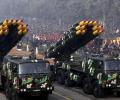
After lagging behind the broader market over the past three and six months, defence sector stocks have regained ground, reversing their performance from the past month. Concerns about slowing order inflows, execution hurdles, supply chain disruptions, and high valuations had weighed on the sector.

After a strong run in the midcap and smallcap indices, which surged 46 per cent and 43 per cent, respectively, on the National Stock Exchange (NSE) during Samvat 2080, analysts suggest that the rally in these segments may pause to catch its breath in Samvat 2081.

'Higher interest rates make gold less attractive as it doesn't generate yield.' 'However, with rates set to fall, the tables are turning for gold.'

In the shadows of a sliding rupee, India's knitwear hub Tiruppur is weaving a success story. While the domestic currency edges closer to the 86 mark against the US dollar, triggering concerns for many sectors, this textile town in Tamil Nadu is finding opportunity in adversity: Between April and December alone, Tiruppur's exports reached Rs 26,000 crore, almost eclipsing last financial year's total of Rs 30,690 crore.

Global financial markets are not yet fully factoring in any escalation in the Israel-Palestine geopolitical conflict, said Christopher Wood, global head of equity strategy at Jefferies in his latest weekly note to investors, GREED & fear. The pertinent point about ongoing events in West Asia from a financial market perspective, according to him, is that, despite much talk about a pending ground invasion of Gaza, no such invasion has yet happened. "This is beginning to make GREED & fear wonder if it is ever going to happen.
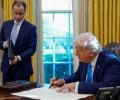
The stage may be set for a recalibrated US-Iran relationship, suggests Ambassador M K Bhadrakumar.
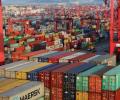
India's merchandise exports in April 2024 marginally rose to $34.99 billion from $34.62 billion in the year-ago month, according to government data released on Wednesday. Imports too increased to $54.09 billion from $49.06 billion in April 2023.

The incident remains a reminder of the inherent fragilities of all geopolitical relationships.

Gold, a safe-haven bet, is likely to continue its record-smashing journey in the New Year, rising to Rs 85,000 per 10 grams and even Rs 90,000 level in domestic markets if geopolitical tensions and global economic uncertainties continue.

Though he does not know what New Delhi is intending to do, Berlin would "welcome any engagement", he added.
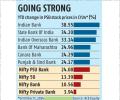
Stock Market News today, PSU banks: The year 2024 was a roller-coaster ride for Indian stock markets, marked by volatility driven by the Lok Sabha elections, Union Budget 2024, a slowdown in corporate earnings, and sticky inflation. Geopolitical tensions - particularly between Israel and Iran in West Asia - along with various stimulus announcements by China and yen carry trade rocked the equity markets throughout the year.

The narrative on China is changing post the recent stimulus measures, and it will be hard for global investors to ignore the Chinese markets.

New investors should gradually build a 5 to 10 per cent allocation to gold.

... and there is no stopping its pan-Islamic agenda, cautions Ambassador M K Bhadrakumar.

US strikes on Iran's three main nuclear facilities have once again raised concerns that Tehran might shut down the Strait of Hormuz - one of the world's most critical chokepoints, through which a fifth of global oil and gas supply flows.

'The first and most basic responsibility of any government is to protect its people from external threats and internal harm.' 'Budget 2025-2026 has to focus on meeting this responsibility,' asserts R Jagannathan.
